Society Publications
Here we highlight books having a life saving theme which have been published by LSARS or published elsewhere by LSARS Members.
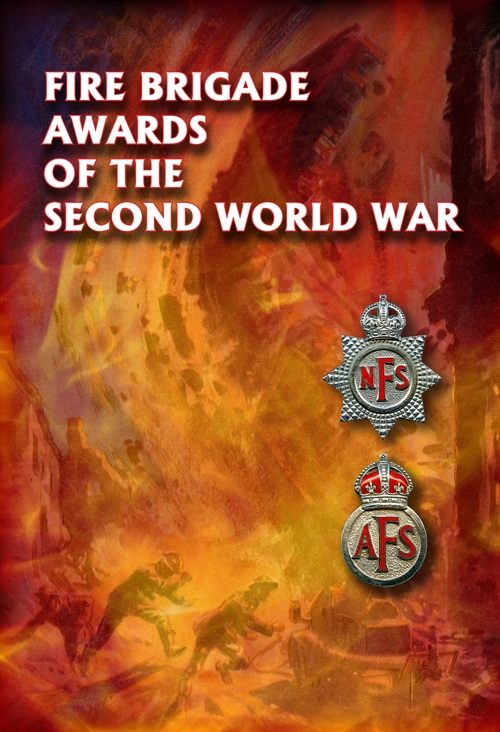
Fire Brigade Awards of the Second World War.
Published by the Life Saving Awards Research Society, 2017. Size 168mm x 245mm, soft bound with colour cover, 284 pages, many black & white illustrations.
Another monumental effort by seven members of LSARS, this book will be of considerable value to all collectors and researchers of awards to fire officers. There is little or no text, save for the citations relating to the various awards made to the subjects of the book and inspiring reading they make, too. Just dealing with a fire in peacetime situations must be traumatic enough but these men and women had to contend with being under fire as well, in the shape of enemy bombing. The book is also a notable example of how awards within the Order of the British Empire reflect the recipients’ perceived place in society – a situation which persists to this day. Apart from the main body of the book, which is essentially a Roll of Honour, there are five interesting appendices, one of which discusses an award to Boy Messenger Neil Leitch of Glasgow in 1941. It mentions the possibility of 'reviving' the Albert Medal in his case, although the AM was still being awarded at that time, both in Gold and Bronze. Though recommended for the GC, he eventually received a posthumous King’s Commendation, the official honours system being as much of a dog’s breakfast then as it appears to be now! Appendix 3 lists a staggering 808 persons being killed in the course of their duties or dying as a result of them, although this is at variance with the official figures, which give only 693. There are photographic images of eighteen personnel and fifteen drawings or paintings, though it seems odd that only one of the three GCs was selected to be the subject of a painting. A most interesting read and full of useful information.
Allan Stanistreet
Free to members of LSARS; £9 plus postage costs to non-members. Contact the Journal Editor for details or to obtain your copy.

The Burning of the Sarah Sands by Roger Willoughby and Alan Cole.
Published by the Orders and Medals Research Society, 2018. Softback, illustrated, 176 pages, black and white and colour plates; £9.00 (£7.00 OMRS Members). ISBN 978-0-9957505.
While my medal interests do not extend to Victorian campaigns, my interest in military history does, so it was with great pleasure that I was able to review this book. The 'headline' story of the troopship Sarah Sands, is widely known: ship catches fire, stoic British soldiers save the day, no lives lost and another epic tale of the British Empire. However, the detail is far more interesting.
The first interesting detail, and more generally know fact, is that the commanding officer of the 54th Regiment of Foot, Lieutenant Colonel Bowland Moffat, was absent from the ship for the 14 hours of extreme danger which marked the event and which he was only able to watch from the relative safety of a lifeboat some hundreds of yards away. The factors leading up to the departure of Lt Col Moffat, and which kept him away from the ship, are sympathetically described in detail as is his subsequent fate. While he was never censured for his departure, his reputation never fully recovered and he was removed from command of the 54th after it reached India.
The second interesting detail, and this time much well known, is the quest to have a Victoria Cross awarded for the incident. This resulted in many years of campaigning and a change in the warrant for the Victoria Cross. This would ultimately be unsuccessful in the Sarah Sands for a very simple reason, but in no small part due to an unhelpful and obstructive civil service; the Sarah Sands amendment to the warrant for the Victoria Cross allowed the award for acts where the test of courage was not changed but the circumstances and danger did not need an enemy to be present. This amendment stood from 1858 until 1881 and resulted in the award of the Victoria Crosses for two incidents.
It would be easy to think that once the fire had been extinguished the passengers' troubles would have been over, but this was not the case as the ship was now an iron wreck held together with wood and rope and stranded in the middle of the Indian Ocean. The passengers then faced a slow passage to Mauritius in the constant fear that the ship would founder. So afraid were they that some wrote their accounts on paper, sealed them in bottles and then cast them over the side in the hope that if the worst should happen, the world would know their fate.
The book is produced to the normal high standards of the OMRS and will withstand prolonged use. This is just as well as there are no fewer than eight appendices covering the individuals involved and their medals. A thoroughly absorbing and useful book which is obviously the product of painstaking research and effort; it is a credit to the authors.
Steve Butler
Note:
Not specifically mentioned in this review is the fact that three life saving awards were made, these being Royal Humane Society silver medals. An article – The Burning of the Sarah Sands; the Life Saving Awards - which tells the most interesting story of these awards, and the controversy that surrounded one of the awardees was published in Journal No. 92.
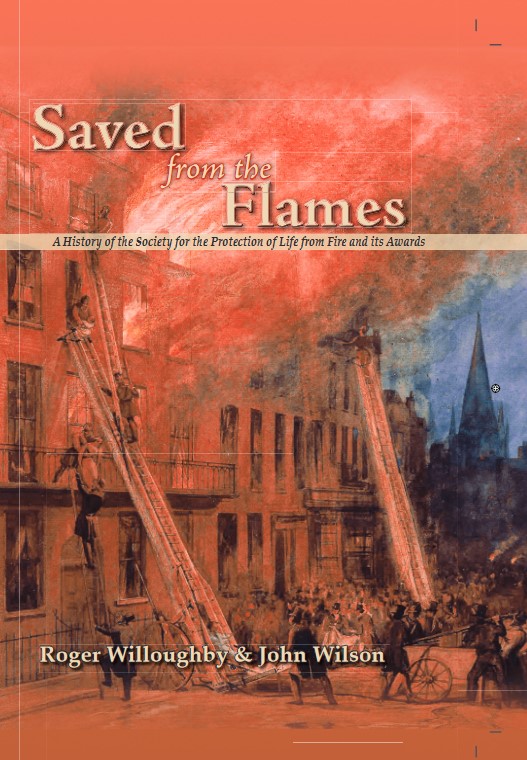
Saved From the Flames
A history of the Society For The Protection Of Life From Fire and its awards, by Roger Willoughby & John Wilson.
Saved from the flames tells the story of the Society for the Protection of Life from Fire, from its origins as a charity established during the reign of William IV, through its Victorian heyday and the turbulent years of the twentieth century, up to the present. Counting Queen Victoria, the dynamic Captain George Manby, the fashionable portrait painter Abraham Wivell, and other notables among its subscribers and officers, the Society itself pioneered fire rescue services in Britain at a time when the rudimentary fire brigades organised by the insurance companies had the protection of property as their prime imperative. Following the formation of the Metropolitan Fire Brigade in London, the Society's fire-escape establishment merged with them in 1867. The Society continued to supply mobile fire-escapes to other local authorities for some years, before becoming in 1881 a purely humane society distributing medals, watches, testimonials and other awards.
Going into blazing buildings, vehicle wrecks and other situations where fires occur, in search of - typically - strangers takes very considerable courage, even for those trained for the task. From its beginning, the Society has sought to reward those men, women and children who have shown such bravery and often placed their own lives in danger in an effort to save others. The names of many of those decorated by the Society are recorded here, together with details of the dramatic events and sometimes tragedies that formed a catalyst for their actions. The present work also serves as a record of those saved and as a memorial to those who have died in the fires here documented over the course of the past 175 years.
Click Here to download this book in PDF format.

For Service in the Cause of Humanity: The Life Saving Awards of the Order of St John. Edited by Roger Willoughby & John Wilson.
Published by the Worcestershire Medal Service in association with the Order of St John February 2024, Hardback, xiv + 347 pages, profusely illustrated throughout in colour and b/w, with colour dust jacket, £39.99 plus postage. ISBN 978-0-9955531-4-9
Marking the one-hundred-and-fiftieth anniversary of the founding of the Order of St John's Life Saving Medal, and the subsequently introduced Certificate of Honour, For Service in the Cause of Humanity, critically documents the previously untold story of these highly prestigious but little-known awards. Following a detailed discussion of the history and politics of the medals and Certificate of Honour, the book reveals the amazing circumstances behind the awards to the 1,394 people who gained them for their brave and humanitarian actions in 44 countries across the world. The book thus contributes to the enduring recognition of the public-spirited bravery of each and every recipient and offers at the same time a rich legacy to contemporary generations. The book concludes with useful appendices highlighting the 138 female recipients of these awards, the countries where each of the 1,394 awards were won, and a classification of each rescue by type.
Available online from: The Great British Bookshop at www.thegreatbritishbookshop.co.uk/products/for-service-in-the-cause-of-humanity and from amazon.co.uk
So far, the following endorsements and advance reviews have been received:
Click Here to download a preview of this book in PDF format.
A landmark contribution to the history of the Order of St John, For Service in the Cause of Humanity, has taken seven years' work to bring it to fruition. The book should find a wide readership both among all those ever associated with the Order, and with those interested in social history, humanitarian actions, and the recognition of civil bravery. It is a fine book which records fine actions, and I am pleased to recommend it to everyone.
The Grand Prior, HRH the Duke of Gloucester
Subjugation of self to the service of others is the raison d'être of the Order of St John and is perhaps best cited as "Service to our lords the sick and the poor" and in our second great motto, "Pro Utilitate Hominum". This excellent publication chronicles the highest levels of such service and sacrifice, with recipients of Order's life saving awards placing their own lives at considerable risk and on some occasions paying the ultimate price in the service of others. These moving accounts of great courage and selflessness are both confronting and hugely inspiring. I congratulate and thank those who have produced this book and I highly commend it to anyone who has an interest in service, bravery and what is possible in all of us when confronted by circumstances where others desperately need assistance.
Professor Mark Compton, AM, GCStJ
Lord Prior, Order of St John
Chairman, St John International
A thoroughly researched and most interesting book which adds much to our knowledge of this aspect of the history of the Order of St John.
Dr Matthew Glozier, OStJ, JP
Deputy Librarian of the Order &. Librarian of the Priory in Australia.
Too often we fail to recall important parts of our history. This wonderfully researched book recalls the dedication, faithfulness and above all the courage in service of some amazing officers.
John Whitehead, CNZM, KStJ
Chancellor Hato Hone St John
Member of the Trustees Executive Committee of the Order.
This book captures amazing stories of courage and commitment to protect and save the lives of others. It serves as an enduring reminder of their service and sacrifice.
Todd Skilton, OStJ, ED, JP
Librarian of the Order
Librarian of the Priory in New Zealand.